
Hiingers — Emergency Resource Negotiation
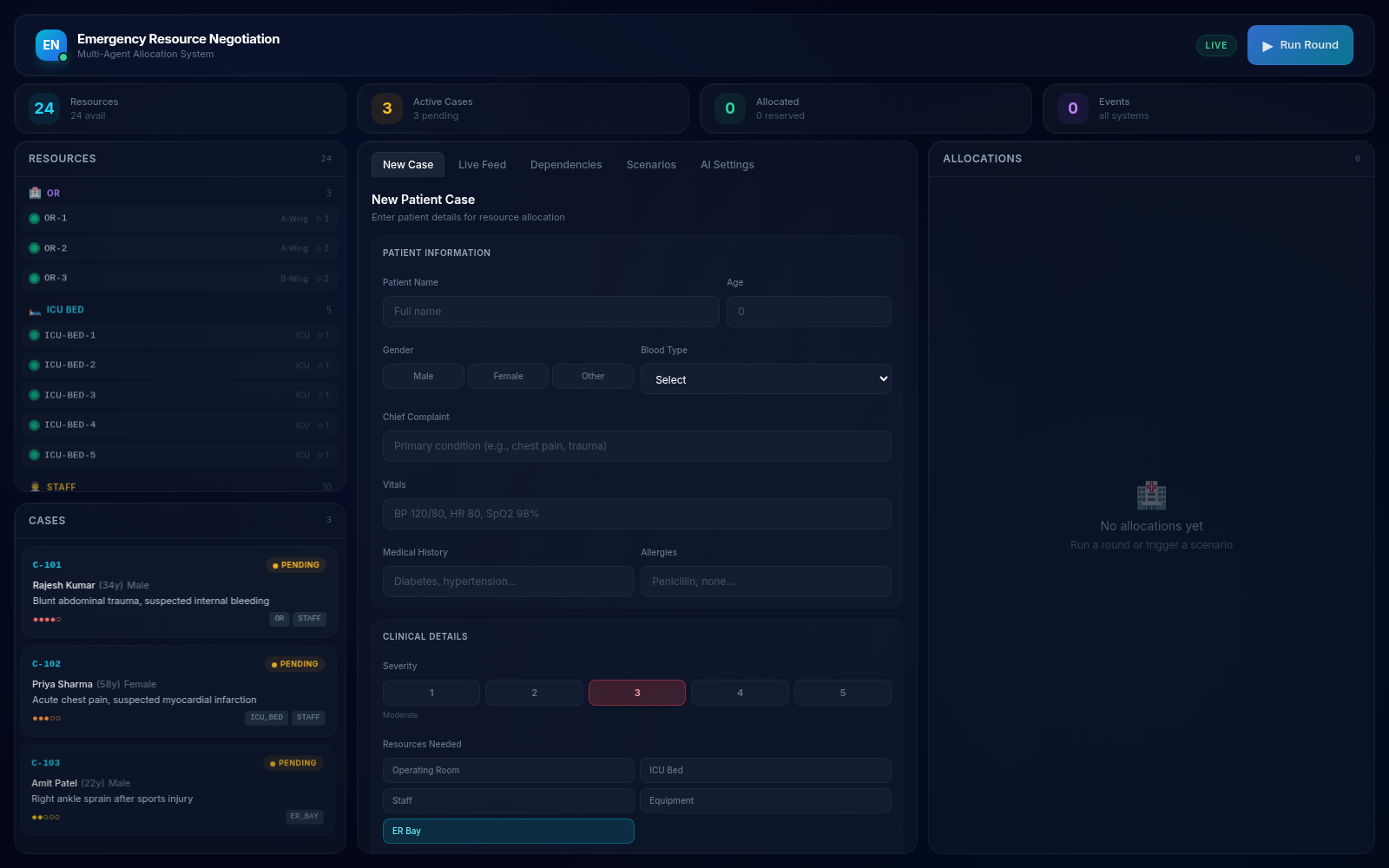
A multi-agent negotiation platform that reallocates scarce hospital resources — ORs, ICU beds, staff, equipment — in minutes during mass-casualty events, using transparent, explainable AI agents.
Screenshots
The problem
During mass-casualty events, hospitals have to reallocate scarce resources — ORs, ICU beds, staff, equipment — under time pressure, usually through phone calls and manual coordination. Decisions are slow and hard to audit after the fact.
The approach
Every resource is modeled as an autonomous agent that bids on incoming patient cases using a transparent multi-criteria scoring function. A fairness-aware coordinator resolves each bidding round using greedy-augmenting matching with anti-starvation aging, so no case gets perpetually outbid.
Stack & why
- FastAPI — async-friendly for handling concurrent bidding rounds over WebSocket
- WebSocket — real-time bid updates instead of polling, since negotiation rounds need to resolve in seconds
- React + TypeScript — frontend for visualizing live negotiation state
- Docker — consistent local/deploy environment for the multi-service setup
Architecture
Python/FastAPI backend (uvicorn) with a real-time WebSocket feed, React frontend, Docker Compose orchestration, and a dependency graph that detects when a reallocation would destabilize other resources.
Trickiest parts
Balancing fairness and speed across negotiation rounds, and making every allocation fully explainable end to end.
How I solved them
A transparent scoring breakdown for every decision, dependency-graph safeguards, and a live bid-by-bid WebSocket feed so nothing is a black box.
Results
Live demo deployed on Vercel with a working multi-agent negotiation loop and per-decision explainability (every allocation decision shows the scoring breakdown that produced it).
What I learned
Explainability isn't a feature — it's the contract users trust. A hospital coordinator won't act on a black-box allocation during an emergency; showing why an agent won a bid is what makes the system usable, not just functional.